
David W Martin Law
Transforming David W. Martin Law’s Online Presence with Proven SEO Strategies
- 400%↑Leads
- 4X↑Web Traffic
- 96%↑Page 1 Rankings






Traditional SEO alone is no longer enough to maintain consistent online visibility or lead flow for law firms. The way people search for legal services is changing fast. Instead of typing short keywords into Google, users increasingly ask full questions in AI-powered tools such as ChatGPT, Google AI Overviews, Perplexity, and Grok.
At Attorney Marketing Network, we help law firms adapt to this shift through AI SEO for lawyers, a strategy designed to keep your firm visible not only in traditional search engines but also in AI-generated answers, where future clients are already looking.
AI SEO ensures your law firm is discoverable, referenced, and recommended across conversational AI platforms, search-generated answers, maps, and local listings where legal decisions now begin.
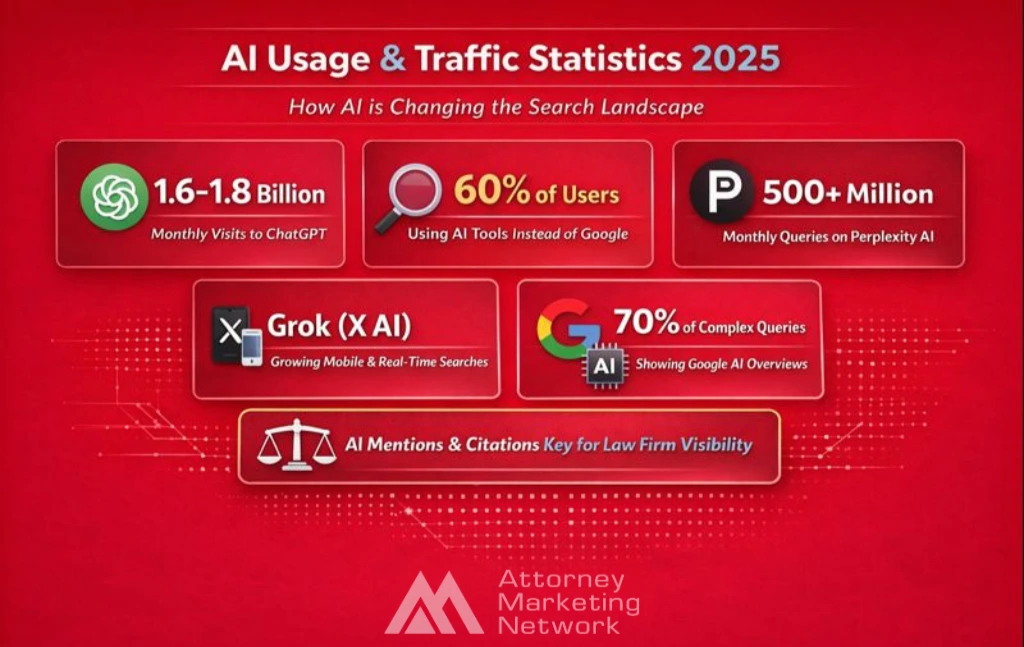
Usage data from 2026 shows a clear shift toward AI-assisted discovery:
For law firms, this means search traffic is no longer just clicks; it’s brand mentions, citations, and recommendations inside AI answers.
AI SEO for law firms goes beyond traditional SEO by optimizing your website for AI-powered platforms like ChatGPT, Google AI Overviews, and other conversational tools. As users now ask more detailed, conversational questions, AI SEO focuses on creating content that AI algorithms can easily understand, positioning your firm as an authoritative source for legal guidance.
By combining AI SEO with traditional SEO, we help your law firm stand out in both organic search results and AI-driven platforms, ensuring visibility when clients seek legal assistance through AI tools.
Search behavior is evolving. Today, people ask detailed questions rather than typing in simple keywords. AI-powered search engines, such as those used by chatbots and AI-generated answer systems, now focus on understanding the meaning behind queries, not just matching keywords. This shift in search behavior requires law firms to adapt their SEO strategies to align with AI tools that assess relevance, authority, and trust.
While traditional SEO remains important, integrating AI-focused strategies is key. AI SEO enhances traditional practices like content creation and backlink acquisition, making your content more understandable and trustworthy to AI systems.
By combining the two approaches, your firm can appear on both search engines and AI platforms.
| AI SEO Traffic vs Traditional SEO Traffic | ||
| AI-driven traffic behaves differently from traditional organic visitors. | ||
| Metric | Traditional SEO | AI-Driven Traffic |
|---|---|---|
| Query type | Short keywords | Long, conversational questions |
| Click behavior | SERP clicks | Direct recommendations |
| Brand importance | Moderate | Very high |
| Local signals | Maps + reviews | Maps + reviews + mentions |
| Conversion intent | Mixed | High-intent, research-ready |
Google’s AI Overviews, the AI-generated summaries that now appear at the top of search results for complex queries, have fundamentally changed what it means to rank #1. Even if your firm holds a top organic position, an AI Overview can appear above your listing and direct the searcher’s attention to whichever source Google’s model deems most authoritative and clear.
AI Overview Optimization (AIO) is the practice of structuring your law firm’s content so that Google’s AI model selects your website as a cited source within those summaries. Unlike traditional featured snippets, AI Overviews pull from multiple sources simultaneously, meaning your content needs to be both highly authoritative and easy for an AI model to parse and quote.
To consistently appear in Google’s AI Overviews for legal queries, your content strategy should focus on:
Direct-answer formatting: Lead each section with a clear, one-to-two sentence answer before elaborating. AI models favor content that answers the question immediately.
Entity clarity: Explicitly name your practice areas, firm name, city, and attorney credentials. AI Overviews need to connect your firm to specific legal entities.
Cited authority signals: Ensure your firm is referenced in legal directories, bar association listings, and news sources. Google’s AI cross-references these citations before including a source in an Overview.
Structured markup: Use FAQ, HowTo, and Service schema so Google’s crawlers can categorize your content without ambiguity.
Conversational depth: Write content that fully addresses the follow-up questions a user is likely to ask. AI Overviews reward comprehensive topical coverage over thin keyword-matching pages.
Law firms that align their content with these AIO signals are not just competing for the top organic result; they are competing to become the answer itself.
Generative Engine Optimization (GEO) refers to the process of optimizing your law firm’s digital presence so that AI-powered answer engines, such as ChatGPT, Perplexity, Claude, and Gemini, recommend, cite, or directly reference your firm when users ask legal questions.
While traditional SEO targets Google’s ranking algorithm, GEO targets the large language models (LLMs) that power AI chatbots and generative search experiences. These systems do not rank pages the same way Google does. Instead, they draw from training data, live web sources, and structured citations to construct answers, which means the factors that earn a citation from an AI are different from the factors that earn a top organic ranking.
| Factor | Traditional SEO | GEO |
| Target | Google algorithm | LLMs + generative AI platforms |
| Key signal | Backlinks + keywords | Brand mentions + entity authority |
| Content format | Keyword-rich pages | Conversational, question-answer structures |
| Trust signal | Domain authority | Citations across directories, news, and AI-indexed sources |
| Local signal | Google Business Profile | GBP + Bing Places + structured NAP |
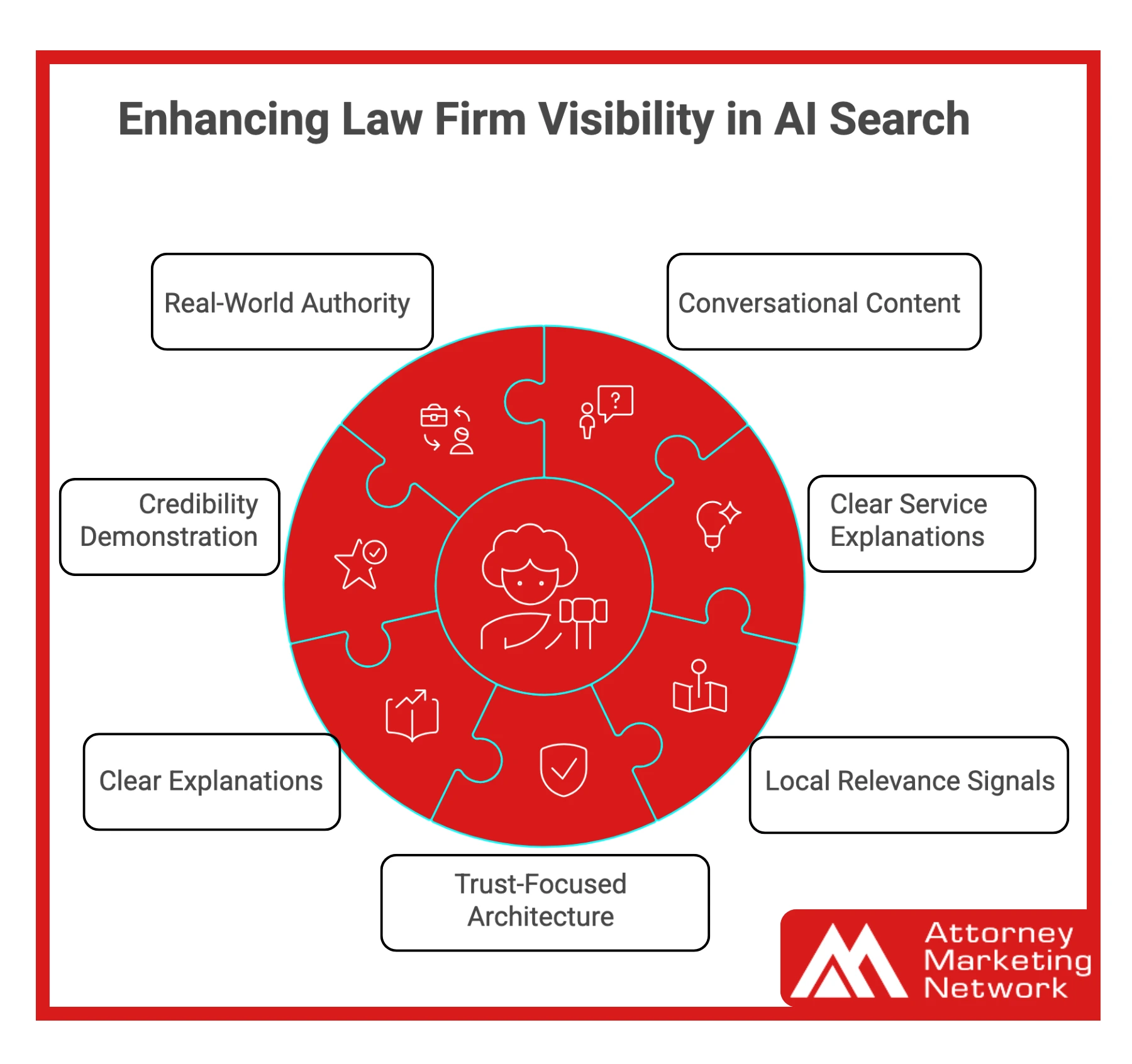
Generative Engine Optimization ensures your firm is recommended by AI systems when users ask legal questions. Strong GEO strategies include:
AI platforms prefer firms that explain answers clearly, demonstrate credibility, and show real-world authority through third-party validation. The more consistently your firm appears across authoritative web sources, directories, news articles, legal databases, and review platforms, the more confidence AI models develop in citing your firm as a recommended answer.
AI engines do not rely solely on links.
They analyze brand mentions across the web, including:
Why this matters:
AI tools “cross-verify” your firm across multiple sources before recommending you.
If your firm is:
AI platforms gain confidence in citing your firm as an answer.
AI systems, including ChatGPT and Copilot, pull local business data from Bing Maps and structured directories.
To improve AI map visibility:
Many AI tools, including ChatGPT and Copilot-powered search experiences, retrieve local business data from Bing Maps rather than Google Maps.
Key optimization steps:
Ignoring Bing Maps limits your firm’s exposure in AI-powered local results.
Generative Engine Optimization (GEO) ensures your firm is recommended by AI systems when users ask legal questions.
Strong GEO strategies include:
AI platforms prefer firms that:
Show real-world authority
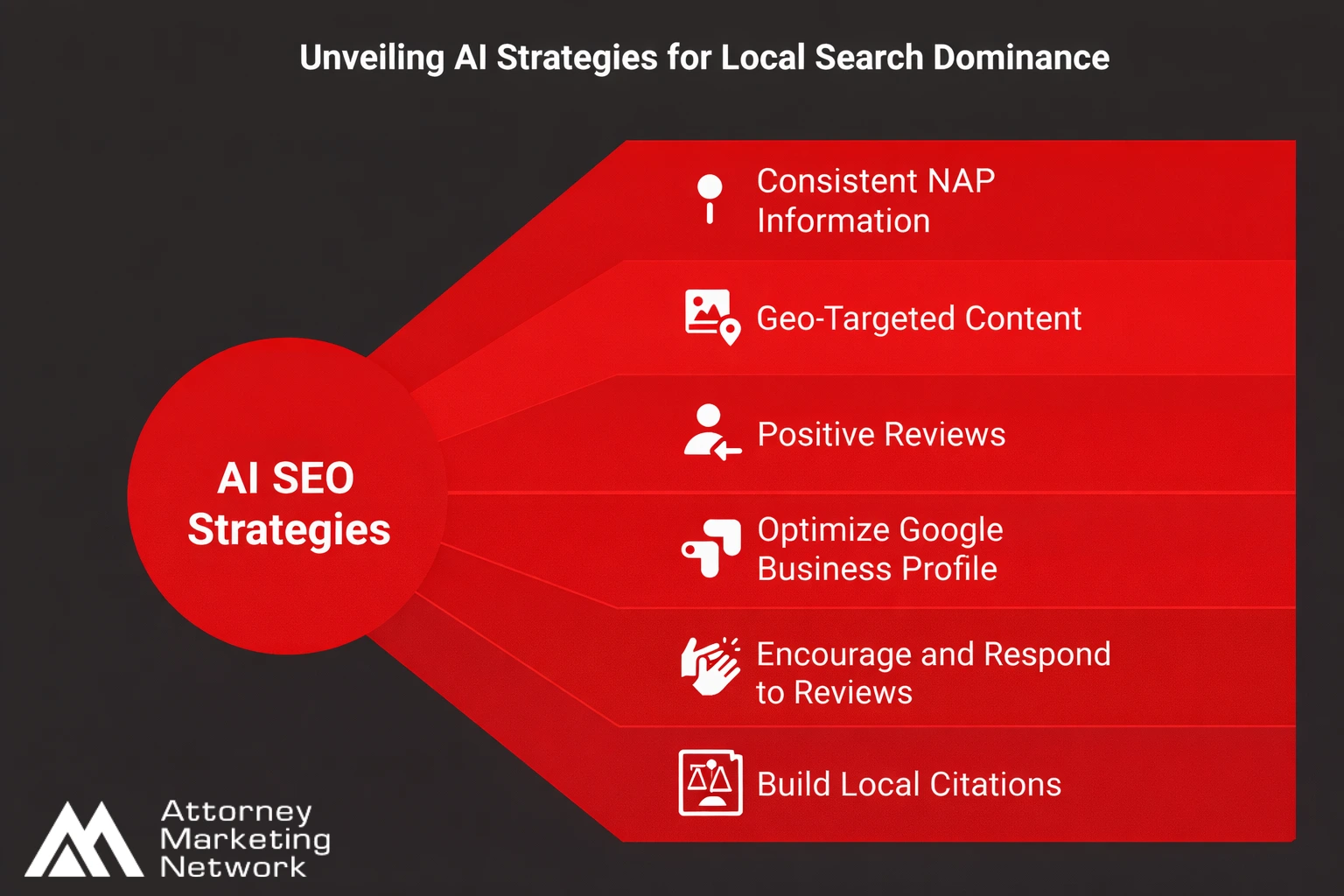
Local search is still vital for law firms. AI hasn’t changed the need for quick, map-based results and reviews. Google’s Local Pack, Maps, and Business Profiles are crucial for connecting with nearby clients.
The Ongoing Importance of Local SEO: When someone needs a lawyer, such as a divorce lawyer, they search for “divorce lawyer near me.” Local SEO ensures your firm shows up in these searches, helping clients find you quickly.
How AI Improves Local Search: AI tools analyze your Google Business Profile, website, and local directories for accurate location data. Optimize for AI-driven local search by:
Winning the AI Map Pack: AI is changing how map pack results are presented. To improve your chances:
AI search requires explicit, direct content. To rank well, your content should be easy to understand and answer questions simply and clearly.
Creating Authoritative and Structured Content: AI values reliable sources. Showcase and trust by:
The Role of FAQs in AI Answers: FAQs are key for AI. Provide direct, concise answers, framed as real questions people ask (e.g., “What damages can I get after a car accident?”). A well-organized FAQ section builds trust and demonstrates.
Ensuring Conversational Tone for AI: While authoritative, your writing should sound natural:
AI SEO is not one-size-fits-all for law firms. The signals that drive AI visibility vary significantly depending on your practice area, because the way prospective clients ask questions, and the way AI platforms are trained to answer them, differ by legal specialty.
Personal Injury Law: AI visibility for personal injury lawyers is heavily weighted toward local signals and review volume. Clients searching for “car accident lawyer near me” or “what should I do after a slip and fall?” expect immediate, location-specific answers. Personal injury firms should prioritize Google Business Profile optimization, local citation building, and outcome-focused FAQ content that AI models can quote in response to injury-related queries.
Family Law: Divorce, custody, and adoption queries are emotionally driven and deeply conversational. AI models frequently pull from content that addresses “how” and “what” questions in plain language, such as “how is child custody determined?” or “what is the divorce process in [state]?” Family law firms benefit most from empathetic, plain-language content structured around the specific questions clients are too embarrassed to ask in person.
Criminal Defense: Defense queries are high-urgency and time-sensitive. AI models responding to queries like “do I need a lawyer if I’ve been arrested?” or “what happens at an arraignment?” look for authoritative, factually precise content from verified legal sources. Criminal defense firms should focus on bar association citations, verified attorney profiles, and direct-answer content covering procedural legal questions.
Immigration Law: Immigration queries frequently involve multilingual intent and national origin signals. AI platforms are increasingly capable of serving location-aware answers to immigration questions in multiple languages. Immigration firms benefit significantly from geo-targeted content, multilingual page variants, and strong presence in immigration-specific directories and government-adjacent citation sources.
Business & Corporate Law: B2B legal queries are researched by professionals, not just individuals in crisis. AI search for business law is driven by topical authority, firms that publish detailed, citable content on contract law, employment compliance, IP protection, and entity formation consistently surface in AI-generated answers for professional queries.
Regardless of practice area, the core AI SEO principles remain consistent: structured content, entity clarity, authoritative citations, and NAP consistency. The execution, however, must be tailored to how your specific clients search and what AI models have learned to associate with trustworthy legal guidance in your specialty.
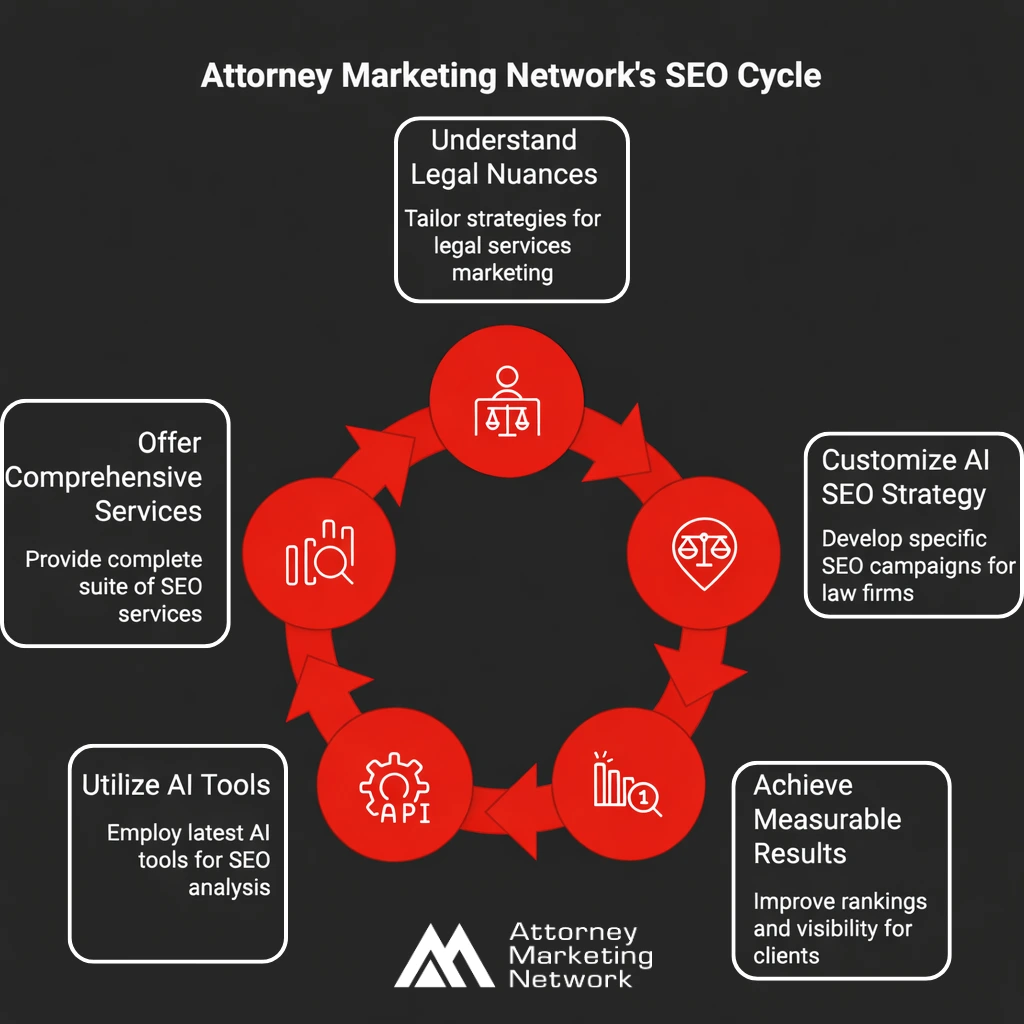
At Attorney Marketing Network, we understand the unique challenges law firms face in the digital space. That’s why we offer AI SEO services for law firms, focusing on creating strategies that drive tangible results.
Here’s why we’re the best choice for your law firm’s SEO needs:
Ready to take your law firm’s online presence to the next level with AI SEO for lawyers? At Attorney Marketing Network, we’re here to help you dominate search rankings and drive high-quality leads.
Contact us today for an SEO audit, and let’s discuss how our tailored AI SEO strategies can help your law firm grow. Whether you’re looking to improve your rankings on traditional search engines or AI-driven platforms like ChatGPT, we have the tools to get you there.
Don’t wait, let us help you get the visibility you deserve!
We’re seeing a significant shift! Many people, over half by some estimates, are now using AI tools like ChatGPT and Gemini to find answers, including looking for lawyers. If our firm isn’t visible on these platforms, we’re missing out on a vast number of potential clients who are searching for help right now.
Traditional SEO focuses on getting our website to appear in regular Google search results, such as the 10 blue links. AI search optimization, also called Answer Engine Optimization (AEO), is about ensuring our firm’s information is used by AI chatbots and search results to provide direct answers when people ask questions such as ‘Who is the divorce lawyer near me?’
Not really. Law firms have rules, such as state bar ethical advertising guidelines, that general SEO agencies often don’t understand. AI search also requires specific knowledge about how AI ‘crawlers’ work and how to get our content seen by them. It’s about working with an agency that truly understands legal marketing and AI.
AI SEO for law firms is a cost-effective investment that boosts your visibility in AI-driven search results, making it easier for potential clients to find you. Pricing varies based on practice area, competition, and target locations, but it’s a smart alternative to traditional lead-generation methods. Contact us today for a free audit and to explore the pricing options for your firm.
We’ve seen a few common missteps. Hiring an agency that doesn’t specialize in legal marketing is a big mistake. Others include failing to prioritize local search, ignoring client reviews, using generic content that doesn’t demonstrate, and, most importantly right now, failing to prepare for or optimize for AI search engines.
Yes. AI-driven search prioritizes relevance and clarity over firm size, allowing well-optimized smaller firms to appear alongside larger competitors.
Yes. AI SEO prioritizes relevance and clarity over firm size, enabling law firms to compete effectively in highly competitive practice areas.
AI SEO and traditional Google SEO are complementary, not competing. The structured content, E-E-A-T signals, schema markup, and citation-building that help your firm appear in AI-generated answers are the same signals Google’s core algorithm uses to evaluate quality and authority. In practice, law firms that invest in AI SEO consistently see improvements in both their AI platform visibility and their traditional organic rankings simultaneously. The content depth and trust signals required for AI citations raise the overall authority profile of your entire website.
These three terms are related but distinct. AIO (AI Overview Optimization) specifically refers to optimizing for Google’s AI Overview summaries that appear at the top of Google Search results. GEO (Generative Engine Optimization) is the broader practice of optimizing for all generative AI platforms, including ChatGPT, Perplexity, Gemini, and Copilot, so your firm is cited in their generated answers. AEO (Answer Engine Optimization) is the older umbrella term for any strategy aimed at getting your content selected as a direct answer, including featured snippets and voice search. For law firms today, a complete strategy requires all three: AIO for Google, GEO for AI chatbots, and AEO for featured snippets and voice.
We should ask them directly! If they only talk about Google rankings and don’t mention optimizing for platforms like ChatGPT, Perplexity, or Google’s AI Overviews, they might not be up to date. We need to see a clear strategy for how they’ll make us visible in AI-powered answers.
Client results






Book a strategy call
Book a free 30-minute strategy call. We'll look at where your firm shows up today in Google and AI answers, and what it takes to win your market.